CPE + Events Catalog
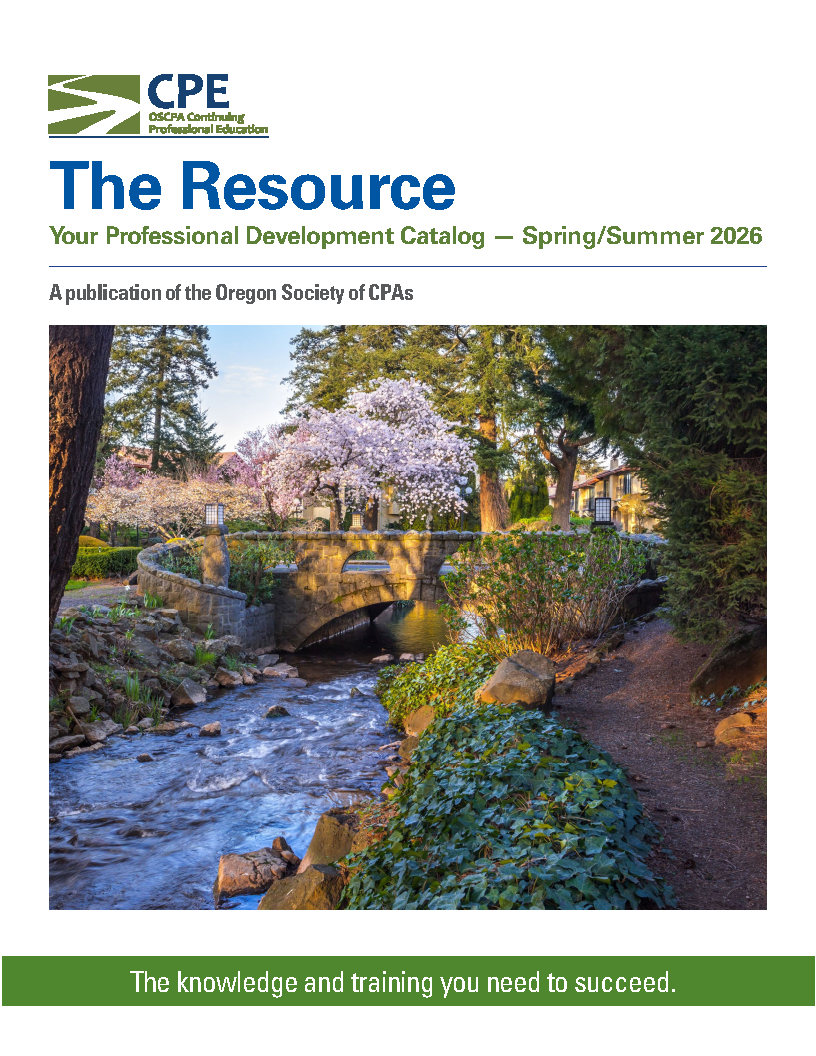
2026-27 OSCPA-Select™ CPE - 2 catalog options:
Browse CPE by Field of Study, and use the Format/Type filter to narrow by In-Person, Webcast, Bundles or On-Demand.
This will generate a PDF of the current filtered catalog
Thinking Like an Auditor When Preparing Your Financial Statements (2 hours)
-
Online
2.0 Credits
Member Price: $89
See more dates
External auditors understand concepts like materiality, reasonableness, and risk of material misstatement. This course will explain how to think like an auditor when preparing and fairly presenting your financial statements and related disclosures.
More Dates
FASB Update and Review (2 hours)
-
Online
2.0 Credits
Member Price: $89
See more dates
Periodic FASB checkups are critical for accountants who deal with financial statements prepared in accordance with U.S. GAAP. This course introduces recent FASB pronouncements and revisits selected existing standards that are likely to be salient for private entities. This session also offers a preview of coming attractions by examining significant elements of the FASB's technical agenda.
More Dates
How SAS Nos. 134-145 Improve Risk-Based Audits (4 hours)
-
Online
4.0 Credits
Member Price: $149
See more dates
Recent generally accepted auditing standards were written to improve the quality of risk-based financial statement audits, audit reporting, and required by-product communications. This course will discuss the important clarifications and enhancements intended to improve audit quality to ensure better compliance with requirements contained in SAS Nos. 134-145. This event may be a rebroadcast of a live event and the instructor will be available to answer your questions during the event.
More Dates
A Guide to Sampling - Part 1 (2 hours)
-
Online
2.0 Credits
Member Price: $89
See more dates
Sampling is often identified as a common audit deficiency in peer review. This course will review when is sampling applicable and basics of planning a sample. We'll then focus on the application of sampling in financial statement audits with a look at sampling for substantive procedures. We'll look at the use of monetary unit sampling and tools that can be leveraged to reduce bias in sampling. YELLOW BOOK: Qualifies for Yellow Book CPE based on your unique audited entity.
More Dates
How to Audit Cash (2 hours)
-
Online
2.0 Credits
Member Price: $89
See more dates
Cash is essential to every business, and is often one of the first accounts audit staff are exposed to. This course will cover the basics of auditing cash, including the related audit assertions, risks, & threats to the cash balance. During this course, we will also highlight the various substantive auditing procedures that staff should perform, and also walk through some real-world examples. This event may be a rebroadcast of a live event and the instructor will be available to answer your questions during the event.
More Dates
Improve Spreadsheets by Building Controls in Excel (2 hours)
-
Online
2.0 Credits
Member Price: $89
See more dates
In today's data-driven world, spreadsheets serve as the backbone of business and personal productivity. However, creating complex and error-prone spreadsheets can lead to critical mistakes and inefficiencies. This course aims to equip you with the knowledge and tools to build robust spreadsheets, implementing a range of controls and safeguards to ensure data integrity, streamline processes, and maximize accuracy. This event may be a rebroadcast of a live event and the instructor will be available to answer your questions during the event.
More Dates
Risk Wrangling: Surviving the Modern Business Rodeo (2 hours)
-
Online
2.0 Credits
Member Price: $89
See more dates
Risk-based factors are becoming exponentially important considerations for accountants in both public practice and industry. We examine the nature of risks for today’s enterprises while exploring the role of internal controls for mitigating business risks. We also explore SAS 145 and other guidance aimed at risk considerations for professional engagements. Public and private accountants will enhance their capabilities for assessing and addressing risks faced by today’s organizations.
More Dates
Accounting for the Gig Economy (2 hours)
-
Online
2.0 Credits
Member Price: $89
See more dates
Freelance work and other non-permanent employment arrangements are becoming increasingly popular ways for people to earn a living. Although these non-traditional activities offer novel, flexible ways to earn income from diverse sources, they also introduce nuanced recordkeeping, reporting, and attestation issues. We investigate characteristics of the gig economy, employee-versus-contractor considerations, bookkeeping, regulatory compliance, and external reporting considerations. We also explore best practices for CPAs who fulfill the role of trusted advisor for gig economy clients. This event may be a rebroadcast of a live event and the instructor will be available to answer your questions during the event.
More Dates
Drive Results with Metrics (2 hours)
-
Online
2.0 Credits
Member Price: $89
See more dates
Many organizations struggle to keep budgets current in an ever-changing business climate. Twenty-first century performance metrics focus on determining what budgets should be rather than what they were in the past. Using performance metrics effectively reduces work, reduces politics, provides flexibility and substantially improves the performance management process. This session will show you powerful techniques to drive your organization’s performance.
More Dates
What's Behind the Data? (2 hours)
-
Online
2.0 Credits
Member Price: $89
See more dates
We are bombarded with information continually. So how do we determine what is valid and what isn't? This course points out common pitfalls inherent in data interpretation and gives practical tips to overcome those pitfalls by using real life examples. The course incorporates information from key thought leaders including Adam Grant, Alex Edmans, and Hans Rosling. This event may be a rebroadcast of a live event and the instructor will be available to answer your questions during the event.
More Dates
Forensic Accounting and Evidence Preservation in QuickBooks (4 hours) - 2 Tech & 2 [NT]
-
Online
4.0 Credits
Member Price: $149
See more dates
By the time a client calls you about suspected fraud, the clock is already running: records can be altered, evidence can vanish, and every day of delay weakens your case. If your practice touches QuickBooks Online, you need to know how to move fast and correctly. This course walks you through exactly that, from scoping the engagement and preserving the file before anything changes, to gaining access when someone tries to block you. You'll master the Audit Log to recover deleted and voided transactions, examine reconciliation history and bank feeds for tampering, and use Reclass to isolate suspicious activity - the same techniques a trained investigator relies on. You'll also learn to cross-match vendors and employees for shell-vendor and ghost-employee schemes, trace lapping on the revenue side, and spot the AP red flags that confirm what you suspected all along This event may be a rebroadcast of a live event and the instructor will be available to answer your questions during the event.
More Dates
Surgent's Audits of 401(k) Plans: New Developments and Critical Issues
-
Online
8.0 Credits
Member Price: $299
See more dates
One of the most favored employee benefit plans, the 401(k) plan, provides unique challenges for auditors. Through this course, auditors will obtain an understanding of the rules and regulations unique to employee benefit plans and obtain practical guidance on applying them. Auditors will enhance their knowledge of the performance and reporting requirements through real-world examples, best practices, and efficient audit techniques that can be utilized in various audit engagements. Make sure your audits don't trigger a DOL inspection by conforming to all applicable rules and regulations.
More Dates
Auditing Standards: A Comprehensive Review 26-27 (16 hours)
-
Online
16.0 Credits
Member Price: $589
See more dates
From understanding fraud requirements to improving risk assessment procedures and from testing to meeting auditing standards, discover ways to audit more effectively and efficiently. Engage in discussions that cover reducing risk and effective planning, research and documentation. Review various case studies, real-life examples and sample documentation will reinforce ideas. This course meets the specific California Board of Accountancy requirements that CPAs are required to meet for re-issuance of their license.
More Dates
2026/27 Annual Update for Accountants & Auditors (4 hours)
-
Online
4.0 Credits
Member Price: $149
See more dates
This comprehensive annual update brings together key accounting and auditing developments affecting accountants and auditors across industries. The course combines recent standard-setting activity issued by the Financial Accounting Standards Board with major audit and attestation updates from the AICPA, providing a well-rounded view of changes impacting financial reporting and engagement performance. Participants will begin with an overview of recently issued and upcoming Accounting Standards Updates (ASUs), including standards effective for December 31, 2026 year-ends for public companies, private entities, and not-for-profit organizations. The course also highlights issued ASUs with future effective dates and provides high-level insight into recent exposure drafts to support implementation planning. The course then shifts to auditing and attestation developments, including the next phase of quality management with a focus on monitoring and remediation requirements. Participants will also review recent and proposed standards affecting audit, attestation, and consulting engagements, including SSAE No. 24, SSARS No. 26, exposure drafts related to confirmations and fraud, and SAS No. 149 addressing group audits. Designed for preparers, auditors, and firm professionals, this course helps participants understand how recent accounting and auditing changes intersect-and what to watch for as standards and expectations continue to evolve. This event may be a rebroadcast of a live event and the instructor will be available to answer your questions during the event.
More Dates
Building Security and Efficiency With Internal Control
-
Online
8.0 Credits
Member Price: $239
See more dates
A well-designed internal controls system can and will drive all entity objectives. Too many times control creators focus too much on security. It is important to properly balance protection-based measures with those designed to enhance efficiency. This session works to illustrate the power of a strong and well supported control system. It also discusses steps to take in order to establish such a system. This material is becoming more and more beneficial as companies strive to address many new business challenges such as evolving markets, the rapid rate of change in the business world and the notable increase in governmental and industry-based regulation. Those that desire a balanced and workplace enhancing control system should strongly consider this session. This event may be a rebroadcast of a live event and the instructor will be available to answer your questions during the event.
More Dates
The Controllership Series - The Future Role of the Controller Part 1 (1.5 hours)
-
Online
1.5 Credits
Member Price: $79
See more dates
This is a two-part series that discuss new trends and concepts the financial controller should begin to execute in order to truly become a valued member of the senior leadership team. The rapid pace of the evolving technological landscape has promoted changes in how accountants and financial professionals focus attention on strategy and modernize their roles to leverage digital technology. There is increased demand for enhancing flexibility into finance cycles and initiating real-time reporting and insights. These are the core attributes that will assist in transforming the work that controllership function performs. Is the financial controllership prepared to meet future business demands? The IMA® (Institute of Management Accountants) and Deloitte’s Center for Controllership aimed to better understand the current state of controllership and expectations of future demands for controllers and accounting professionals. They conducted a survey in late 2022 and identified several trends. The survey takes a look at how prepared controllership is to meet future business demands. It also highlights some insights for leaders to consider that may increase their preparedness. It also identified areas of additional insight and questions to answer on the controllership transformation journey. In this segment one, we go through numerous concepts in detail and the remaining concepts will be covered in segment two.
More Dates
Accounting Analysis Basics 26-27 (4 hours)
-
Online
4.0 Credits
Member Price: $175
See more dates
Develop financial reporting expertise to conduct an accounting analysis and detect distortions in financial statements. Accounting savvy permits the business analyst to leverage financial information to manage and implement business plans. Gain the tools necessary to become skilled at such analyses. Review the impact of financial and accounting data on the function of capital markets in relation to the changing economic landscape and globalization.
More Dates
Auditing Standards Update & Best Practices 26-27 (4 hours)
-
Online
4.0 Credits
Member Price: $175
See more dates
In every audit, the auditor must identify and assess the risks of material misstatement in the financial statements, whether due to fraud or error. This process includes understanding the entity and its environment, including its internal control, thereby providing a basis for designing and implementing responses to the assessed risks of material misstatement. This program explores efficient ways to conduct audits (primarily for private companies), including discussing the applicable standards and their requirements.
More Dates
Operations Level Internal Control (4 hours)
-
Online
4.0 Credits
Member Price: $149
See more dates
Many leaders in business organizations of all sizes view the system of Internal Control almost purely as a protective security measure. A well-designed internal control system can and will drive all entity objectives which includes successful operations. This session uses information gathered from years of creating internal control systems as well as concepts from well-respected authoritative pronouncements and frameworks to illustrate the power of a strong and well supported control system as well as actions that can help establish such a system. Those that work with internal controls who are tasked with developing ways to improve operation level capabilities should strongly consider this session. This event may be a rebroadcast of a live event and the instructor will be available to answer your questions during the event.
More Dates
Auditing Standards: A Comprehensive Review 26-27 (16 hours)
-
Online
16.0 Credits
Member Price: $589
See more dates
From understanding fraud requirements to improving risk assessment procedures and from testing to meeting auditing standards, discover ways to audit more effectively and efficiently. Engage in discussions that cover reducing risk and effective planning, research and documentation. Review various case studies, real-life examples and sample documentation will reinforce ideas. This course meets the specific California Board of Accountancy requirements that CPAs are required to meet for re-issuance of their license.