
Five priorities for the 2027 filing season
November 13, 2026
By Greg White and George Koutelieris, Cutting Edge Tax Strategies LLC
The 2027 filing season brings new deduction limits, inflation adjustments, consequential court decisions, and mandatory income recognition. We will cover these and other developments at our Federal Tax Updates on January 13 and January 14, 2027. Here are five priorities for CPAs serving individuals, trusts, closely held businesses, and real estate investors, reflecting developments through November 6, 2026.
1. Recalculate individual and fiduciary deductions under the 2026 rules
Beginning in 2026, itemizers face a charitable deduction floor of 0.5% of AGI, while nonitemizers may deduct qualifying cash contributions up to $1,000 ($2,000 jointly). The SALT cap rises to $40,400, phasing down by 30% of modified AGI above $505,000, but not below $10,000; separate-return dollar amounts are half.
Revised §68 reduces itemized deductions by 2/37 of the lesser of those deductions or taxable income (before itemized deductions) above the 37% bracket threshold, generally limiting their benefit to 35%.
OBBBA removed the exemption for estates and trusts. Footnote 102 of the Joint Committee on Taxation’s May 2026 General Explanation treats the §642(b) exemption and §§651/661 distribution deductions as subject to §68. With a $16,000 top-bracket threshold in 2026, this interpretation could tax distributed income at both fiduciary and beneficiary levels.
The nonbinding footnote reads Treas. Reg. §1.67-4’s nonitemized treatment as limited to §67. Preparers should document their analysis, evaluate disclosure requirements, and monitor forthcoming guidance. Model charitable giving, trust distributions, and state tax payments together.
2. Key inflation adjustments for 2026 and 2027
The IRS released Rev. Proc 2026-35 on November 5. Use 2026 amounts for returns filed in the upcoming season; the new 2027 amounts generally apply to returns filed in 2028.
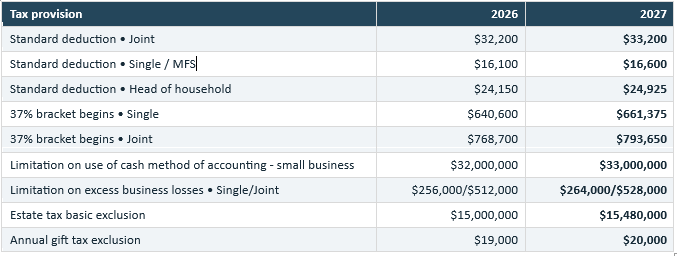
These changes create planning opportunities for gifts, bunching of deductions and income timing. Bracket thresholds refer to taxable income.
3. Anticipate individual return reporting and repayment surprises
The tips, overtime, senior, and vehicle-loan interest deductions continue, with more structured 2026 reporting. Qualified tips and overtime receive separate W-2 codes, and the overtime deduction generally covers only the FLSA-required premium portion.
For 2026, Marketplace premium tax credit eligibility again ends above 400% of the federal poverty level, and repayment caps are eliminated, so even taxpayers below that threshold can owe full repayment of excess advances. Organizers should flag Roth conversions, business income, and capital gains.
4. Revisit self-employment tax treatment for partners
In K Alain (formerly Sirius Solutions), the Fifth Circuit withdrew its January 2026 opinion. Its August replacement asks whether a partner plays a significant role in managing or running the business, leaving its application for remand. In September, the Second Circuit affirmed self-employment tax for the Soroban Capital Partners principals, emphasizing managerial control.
Document actual responsibilities, authority, and activities, and consider the governing circuit. Neither a “limited partner” designation nor limited liability alone is dependable. LLC members require separate analysis; revisit protective claims based on the withdrawn opinion.
5. Prepare for opportunity zone inclusion and the partnership calculation issue
Absent an earlier inclusion event, remaining deferred gain under the original regime is includible December 31, 2026, even without cash. §1400Z-2(b)(2)(A) measures inclusion as the excess of the lesser of deferred gain or fair market value over the taxpayer’s basis, including applicable holding-period increases.
For QOF partnerships, Treas. Reg. §1.1400Z2(b)-1(e)(4) instead uses the lesser of remaining deferred gain, reduced by five- and seven-year basis increases, or gain on a hypothetical fully taxable sale at fair market value. That sale reflects liabilities and adjusted outside basis. Debt-financed losses or distributions can increase inclusion; basis increases from allocated income can reduce it.
A statutory challenge must address §1400Z-2(e)(4)’s specific regulatory delegation, which does not authorize departures from the statutory formula. Protection against the disregard-of-regulations penalty through disclosure generally requires reasonable basis, a good-faith validity challenge, and Form 8275-R. Other penalty standards require separate analysis.
Obtain valuation support, reconcile outside basis and liabilities, and plan liquidity. For calendar-year individuals, annualization can defer estimated payments attributable to December inclusion until January 15, 2027; earlier underpayments on other income remain relevant.
Several issues call for action before December 31, not just at filing. Join us at one of our Federal Tax Updates on January 13, 2027, or January 14, 2027, as we work through these developments and their implications for your clients’ returns and planning.

George J. Koutelieris, CPA, MS-Tax, is a shareholder in the firm Johnson & Shute P.S. and a Member of Cutting Edge Tax Strategies, LLC. He is also an Adjunct Professor at Golden Gate University teaching various tax courses.
George's practice includes planning and consulting on complex transactions including formations, liquidations, mergers and acquisitions, purchase and sales, multi-state and international tax for closely held businesses and their owners, with a concentration on the real estate industry.
George is a member of the American Institute of Certified Public Accountants and the Washington Society of Certified Public Accountants, where he is a former chair of the WSCPA's Taxation Committee. George is also an active speaker on various tax topics, having presented in the past for all the State Societies on the west coast.

Greg White, CPA-WA, has practiced tax accounting for more than 35 years. He is founder, shareholder, and President of CPA firm WGN, P.S. in Seattle, Washington, which serves a successful entrepreneurial client base. He also owns and operates State of the Art Tax, LLC, a tax education company. Greg is in his tenth year as an adjunct professor at the Golden Gate University's Seattle Campus where he teaches capital assets, tax accounting, and individual taxation. Greg is licensed to practice in and has argued cases before the U.S. Tax Court. He has been named "Top 50" IRS Practitioner by CPA Magazine.
Greg has extensively presented tax CPE, predominantly on the west coast, over the last decade and has written and presented live courses and webinars for CCH and others nationally. He has presented tax topics in the Pacific Northwest on TV including spots on KOMO TV, King TV, and Northwest Cable News. He is frequently in contact with Treasury, IRS, and other top government officials in Washington, D.C. as to late breaking guidance from the government and has been involved in making recommendations to them to help practically shape federal tax legislation and administrative guidance.
