
Career Resources - Interview tips
Interview Preparation Guide for Students & CPA Candidates
Landing an interview is a big win, now it’s all about showing the employer who you are, what you can contribute, and why you’re ready to grow in the accounting profession. Whether you’re preparing for internships, entry-level roles, or your first post-exam opportunity, this guide walks you through every stage with practical, confidence-boosting tips.

Before the Interview
Strong preparation is half the job. Set yourself up for success by doing the groundwork.
- Look into the company’s services, clients, and culture.
- Review recent news or major announcements.
- Understand where the organization sits within the accounting or finance landscape.

- Study the job description and identify key responsibilities.
- Highlight the skills and experiences you have that directly align.
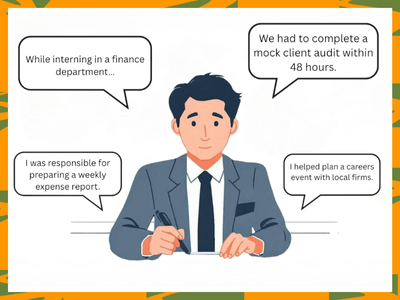
- Prepare for common accounting and behavioral questions (see examples below).
- Use the STAR method* (Situation, Task, Action, Result) to structure your examples.
- Practice out loud – it really helps with clarity and confidence.
- Draft 2–4 thoughtful questions for your interviewer about the role, team, or firm.
- Examples: “What qualities help someone thrive in this role?” or “How does your team support CPA candidates?”

- Plan professional attire that fits the company’s culture (when in doubt, slightly more formal).
- Confirm interview details, format (virtual/in-person), and travel time so you’re not rushed.

Common Interview Questions
These examples pop up frequently in accounting interviews. Preparing for them will help you communicate your value clearly.
- Why did you choose accounting as a career path?
- How do you stay updated with changes in accounting standards and regulations?
- Describe a challenging accounting problem you solved.
- How do you handle tight deadlines and multiple priorities?
- Tell me about a time you worked as part of a team.
- What accounting software or tools are you most comfortable with?
- How do you ensure accuracy in your work?
- What interests you about this specific role or firm?
- Where do you see yourself in the next few years as you work toward your CPA?

During the Interview
This is your moment – here’s how to make it count.
- Listen closely and answer questions clearly and concisely.
- Back up your answers with specific examples from coursework, volunteer experience, jobs, or internships.
- Show enthusiasm for the role and professionalism in how you communicate.
- Remember, you’re interviewing them, too. Ask your prepared questions.
- For virtual interviews: check your tech, find a quiet space, and test your lighting and audio.

After the Interview
The follow-through matters.
- Send a brief thank-you email within 24 hours.
- Reiterate your interest and highlight one or two things you enjoyed learning about the role or organization.
- Reflect on what went well (and what didn’t) to help you prep for future interviews.

If It Doesn’t Go Perfectly - That’s Okay
Interviews don’t always go according to plan, and that’s completely normal. Everyone stumbles over an answer at some point, forgets a detail, or wishes they’d said something differently. What matters most is how you recover and what you learn from the experience. Every interview – even the awkward ones – gives you valuable insight into the process, builds your confidence, and sharpens your communication skills. Treat any mistakes as stepping stones, not setbacks. No matter the outcome, you walk away stronger, more knowledgeable, and more experienced with every conversation, every success, and every misstep. You’ve got this.
Using the STAR Method in Interviews
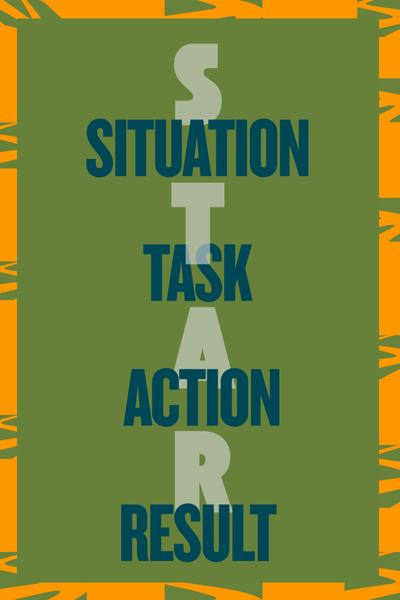
Many employers use behavioral interview questions to understand how you’ve handled real situations in the past. The STAR method is a simple, structured way to answer these questions clearly and confidently.
What STAR Stands For
S – Situation
Set the scene. What was happening? What was the context?
T – Task
What were you responsible for? What challenge or goal were you facing?
A – Action
What exactly did you do? Focus on your steps, decisions, and approach.
R – Result
What happened because of your action? Talk about outcomes, improvements, or what you learned.
How to Use STAR in an Accounting Interview
Situation: During a team project in my audit course…
Task: We had to complete a mock client audit within 48 hours.
Action: I organized the workload, delegated tasks based on strengths, and built a shared checklist to keep us on track.
Result: We submitted early, got full marks, and the professor used our project as an example for future classes.
Situation: While interning in a finance department…
Task: I was responsible for preparing a weekly expense report.
Action: I cross-checked entries, identified an error in a vendor invoice, and flagged it to the team.
Result: We corrected a $2,000 overcharge, and my manager entrusted me with additional reporting tasks.
Situation: As a member of the OSCPA Young Professionals Committee…
Task: I helped plan a student outreach event designed to connect accounting majors with local CPA firms and OSCPA resources.
Action: I coordinated with committee members to identify participating firms, handled outreach to campus accounting clubs, and helped create promotional content for social media and the OSCPA website.
Result: The event drew nearly twice as many students as the previous year, and several firms requested to participate again because of the strong turnout and engagement.
Quick Tips
- Keep your examples short and structured (2–3 sentences per step).
- Focus on your contribution, not just what the group did.
- Use real experiences—jobs, internships, volunteering, group projects, classwork, even part-time roles.
- Have 3–4 STAR stories ready to adapt to different questions.